
AI Regulation for Creators - Spring 2026
A PDF covering the three jurisdictions that matter most, what's in force now, and what's coming before the end of the year.
What creators need to know about training data, labelling, and copyright in 2026. For writers, artists, musicians, journalists, photographers, newsletter publishers, and podcasters.
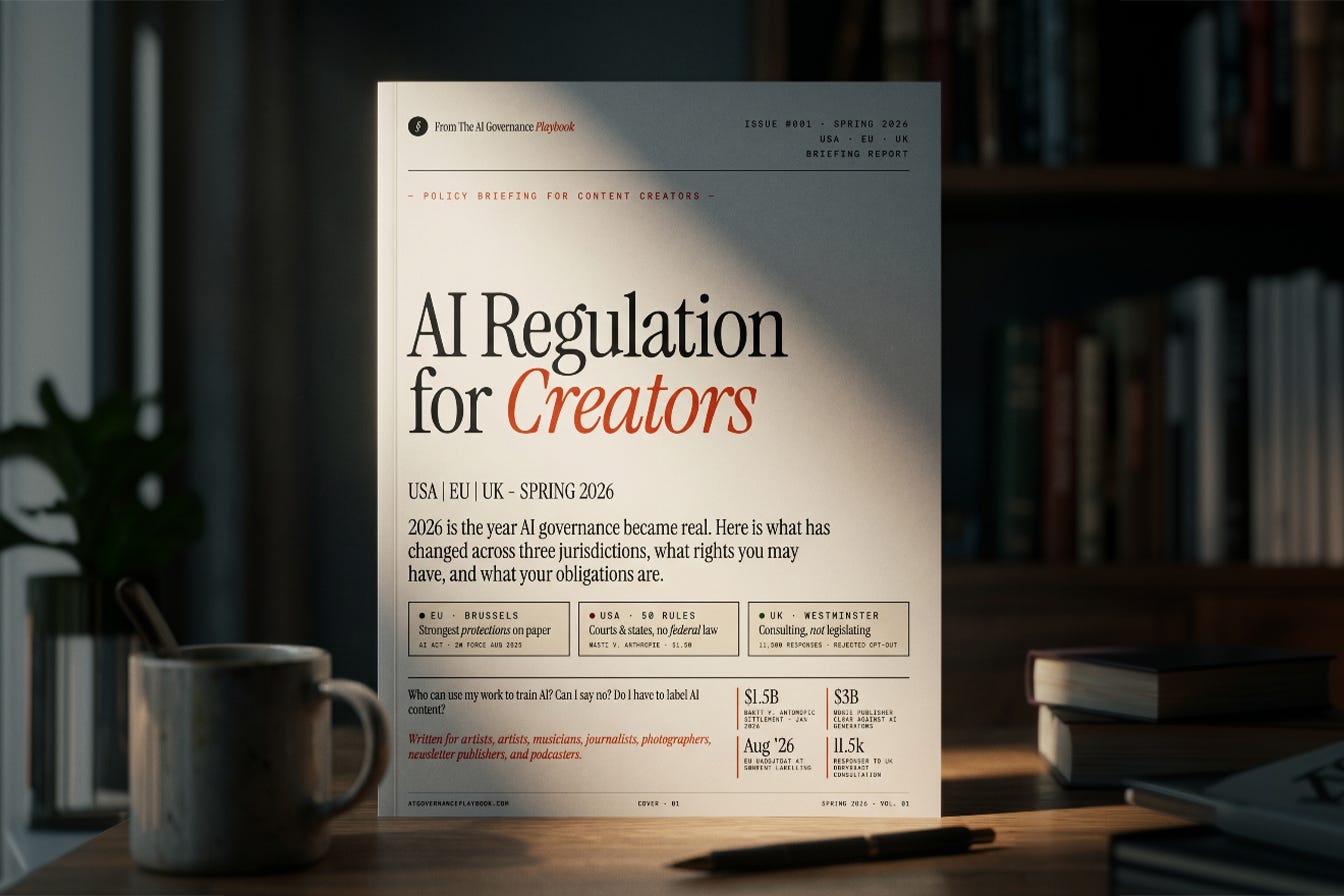
AI Regulation for Creators, spring 2026
I spent the last few weeks pulling together everything a working creator actually needs to know about AI regulation right now, across the EU, the US, and the UK. It’s out today as a PDF, attached to this post.
No jargon. No padding.
The picture across those three jurisdictions is genuinely messy. The EU has the most structured rules on paper, but the opt-out is your responsibility, not the AI company’s. In the US, the courts are doing the work that Congress won’t, and the $1.5 billion Bartz v. Anthropic settlement in January rewrote how AI companies think about training data sourcing. The UK consulted 11,500 people, rejected the opt-out model it spent two years developing, and is now running a market pilot instead of passing a law.
The briefing covers what each of those positions means practically: what you can do today to protect your work, what rights reservations and metadata standards are worth your time, what to watch over the next 90 days, and what you can safely ignore.
There’s also a cross-border checklist on page 10. Eight actions, all available now, most free. If you do nothing else, robots.txt and a copyright registration (if you’re in the US) are worth doing this week.
Read this and …
You’ll know exactly what the EU’s mandatory AI content labelling rules require from you before the August 2026 deadline.
You’ll understand why the Bartz v. Anthropic settlement matters even if you’ve never published a book, and what it means for how AI companies can legally train on your work going forward.
You’ll get a plain-English comparison of where the EU, US, and UK actually stand right now, not where they were headed six months ago.
You’ll find out whether you’ve already opted out of AI training on your content, or whether you’ve accidentally left the door open.
You’ll know which eight actions are available today, cost nothing, and create a legal record that could matter later.
You’ll understand what AI-generated content you can and can’t copyright in all three jurisdictions.
You’ll know what to watch in the UK courts this year, and why the Getty v. Stability AI appeal could change the rules for every creator whose work has ever been scraped.
The PDF is attached below.
Here is the link ….
This briefing is for informational purposes only and doesn’t constitute legal advice. For questions specific to your work, talk to a qualified lawyer in your jurisdiction.
Keep reading with a 7-day free trial
Subscribe to The AI Governance Playbook to keep reading this post and get 7 days of free access to the full post archives.